By Leslie Hunt
A tetrahedron, from which the word tetrahedral is derived, means a solid bounded by four surfaces. In the kite, only two of the surfaces are utilized. A little experimenting will demonstrate that the sides must be triangular. The old puzzle to make four triangles with six matches will serve as an explanation. Lay three matches in the form of a triangle on a table. Hold three other matches between the thumb and fingers, and place the free ends at each angle of the triangle and you have solved the puzzle. If a kite frame is made on the same principle and any two sides are papered, a tetrahedral cell or kite unit is formed.
Doctor Alexander Graham Bell made serious attempts with huge kites made of tetrahedral units to solve the problem of airplane construction and much discussion of the principles was to be found in the magazines between the years 1903 and 1908. I have not found the single units to be as satisfactory as the bow kite, and the United States Weather Bureau has not found them to be as satisfactory for their work as the box kite perfected by Professor Martin. Since the tetrahedral principle is much used in making figure kites, the method for making a tetrahedral cell or unit is described in the following pages.
Since the arrangement of the sticks forms an ideal system of bracing, the sticks may be much smaller in width and thickness than those required for other kinds of kites having the same amount of surface. Prepare seven sticks 1/4 by 1/4 by 26 inches. Lay them on a table so two equilateral triangles are formed and one stick left over. Many ingenious plans have been devised to use six sticks and still provide for folding, but to use the extra stick is the easiest and, in general,

FIG. 31.
TETRAHEDRAL KITE COMPLETE
the most satisfactory. Pare away the wood at the ends, so the triangles will lie flat on the table without rocking. Do not let the ends lap over 1/2 inch. Glue and tie. Lay one triangle over the other and match up the size, shape, and weight. Remove and allow to dry.
Decide which sides of the triangle are to join, and glue a strip of paper to form a hinge while the triangular frames are spread open, and press to position after the frames have been carefully closed. Allow the hinge to dry. Now paper the sides, framework in, and spread the two papered triangles apart and hold in position by lashing the extra stick fast to their upper angles.
Care should be exercised to get the paper at the same tension so the triangles will not be drawn out of shape.
There are various ways of attaching the bridle. One of the simplest ways is to attach a single string to one end of the hinge, and attach the kite line to this string. However, the following is a better method: Cut a string twice as long as the hinge, and tie a loop about one fourth the length of the string. Tie the kite line into the loop, and tie the longer end of the string to the far end of the hinge, and the shorter end to the near end of the hinge. The loop may be too far back, causing the kite to pull flat against the wind. In this case, the kite will not rise. The object in making the string long is to provide for adjustments.
Some patience and a stiff breeze will be necessary for a successful flight. These kites perform remarkably well in a strong wind, and will stand a very great amount of abuse.
After a flight, untie the top stick and fold the kite together.
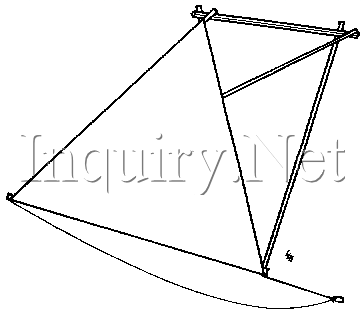
A kite, made according to the above directions, rated 1 ounce per square foot. Since the wings were set at an angle of 60 degrees, the effective surface was only about half the actual surface. It is, therefore, easy to see why this type of kite is adapted to strong winds: it has relatively a small effective surface with great strength and stability. Figure 31 shows the completed kite.
If a larger tetrahedral kite is desired, follow the picture below, making the cells the size of the one just described.

