Home ] Up ] Books ] Search Inquiry ] Contents ]
Estimation


Cooking Lightweight
Cooking Off-the-Shelf
Cascade Mountain Climb
Camp Schoellkopf: October 2007
Equipment, Lightweight
Equipment, Scouting Out
Learn by Doing
The Scout's Staff
Archery
Axe, Boy Scout
Axe, Saw, Forestry
Axe, Saw,  Knife
Axe Use: Beard
Axe Use: Seton
Axe Use: Traditional
Axe Throwing
Beds, Woodcraft
Bedding Materials
Bicycle Maintenance
Birch-Bark Torch
Birds
Bird Houses
Blocks Tackles Purchase
Blood Red Cross
Broom: Camp or Witch's
Buttons
Campcraft
Camp Hygiene
Camp Planning
Campfire Programs
Chainsaws
City-Craft
Compass Bear Song
Compass, Home-Made
Cookery in Camp
Cooking Contests
Cook Dutch Oven Stack
Cooking Hygiene
Cooking Utensils
Cooking Primitive
Cooking Recipes
Cotton Kills Bear Song
Deduction in Tracking
Deduction & Detective
Drum
Dyes
Edible Plants
Equipment, Leader
Equipment, Personal
Equipment Maintenance
Estimation
Field Signals
Fire Building
Fire Laying
Fire Lighting
Fire Starters
Fire: Rubbing-Stick
Fire Types, Wood Types
Fire Council Ring
Fires: Woodcraft
First Aid
First Class Journey
Flint & Steel
Flowers
Forest
Gesture Signals
Ground to Air Signals
Handicraft Stunts
High Adventure
Hiking
Hike Planning
Indian Sundial Clock
Insect Collecting
Insect Preserve
Indian Well
Knife & Hatchet
Knots, Bends, Hitches
Knots: Diamond Hitch
Knots: Lashings
Knots: Rope Work
Knots: Seton
Knots: Traditional
Knots & Whipping
Lashings
Lashing Practice Box
Lace or Thong
Leave No Trace
Lights
Local Knowledge
Log Ladders, Notched
Log-Rolling
Logs: Cut Notch
Logs Split with Axe
Loom and Grass Mats
Lost in the Woods
Manners
Maps
Map & Compass
Maps: Without Compass
Measurement
Measurement Estimation
Menu Worksheet
Menu (Adult IOLS)
Mosquitoes
Mushrooms
Night Tracking
Observation
Old Trails
Paints
Pioneering, Basic
Pioneering Models
Plaster Casts
Preparations
Proverbs
Rake
Rope Care
Rope Making
Rope Spinning
Scout Reports
Signal & Sign
Sign Language
Silent Scout Signals
Smoke Prints
Snakes
Spanish Windlass
Spoons
Staff/Stave Making
Stalking Skills
Stalking & Observation
Stars
Stools
Story Telling
Stoves & Lanterns
Summoning Help
Sun Dial: Scientific
Survival Kit
Tarp Poles
Teepee (4 Pole)
Tent Care
Tent Pitching
Tom-Tom
Tomahawk Throwing
Tomahawk Targets
Totem Making
Totem Animals
Totem Poles
Training in Tracking
Tracks, Ground, Weather
Tracking & Trailing
Trail Following
Trail Signs & Blazes
Trail Signs of Direction
Trail Signs: Traditional
Trail Signs for Help
Trees of the NE
Wall Hangings
Watch Compass
Weather Wisdom
Wild Things
Troop 625


Search Now:


In Association with Amazon.com


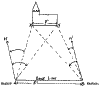
Length of a Building
 estim-1.gif (5503 bytes)
This is your scale drawing of the 
base line which you have paced out (e.g. 50 foot).
Scale 1" = 10' (One inch equals 10 feet)

Place markers (say 50 feet apart). This is your base line. Make a scale drawing of it (5"). At points A and B on the sketch draw in the North point bearing. Take bearings from North at A for each of the church at X and Y. Take bearings of X and Y at B. Mark in these bearings on your sketch using a protractor. Join up line X. and Y between the two points where the lines cross.... If the line X Y measures 2" then the church is 20 feet long.

Personal Measurements

It is important to know your own personal measurements. It also can help to find a measurement on yourself that is exactly one centimeter (maybe a fingernail width), then also find a 10 cm and a 1 meter measurement.

Remember that Scouts' bodies are still growing so personal measurements should be checked an a regular basis.

Here are some more ways of making fairly close estimates of height and distance. You'll be making practical use of some of the basic geometry learned in school.

Pencil Method

Have a friend whose height you know stand against the object for which you want to find the height. Now follow these steps:

1. Hold a pencil or short stick at arm's length, and sight across top of it to the top of your friend's head.

2. Move your thumb down on the pencil until you sight across it to your friend's feet.

3. Raise your arm until your line of sight over your thumb hits the top of you friends head.

4. Note where your line of vision across the top of the pencil cuts object to be measured.

5. Move your arm up again and repeat step 4.

6. Keep repeating steps 4 and 5, counting as you go up, until you reach the top of the object.

How many sightings did you take, including the first one friend? That is the number of times higher the cliff is than the height your friend. Multiply that number by your friend's height to find the height of the object.

Height by Shadow

You might try guessing the height of a tree by using shadow.

1. Get a stick of known length and notch it in meters and centimeter

2. Stand the stick upright in the sun and measure the length of the shadow. 

3. Measure the length of the shadow cast by the tree. 

4. Multiply the stick length by the length of the tree's shadow.

5 Divide by the length of the shadow cast by the stick. The result is the height of the tree. Here is the formula: Tree height = Stick length x tree shadow

1 Stick shadow or Tux ss [?]

For example, if the stick's length is 2 m, the tree's shadow is 20m long, and the stick's shadow is 5m long:

2 x 20/5 = 40/5 = 8 so the tree is 8 meters high

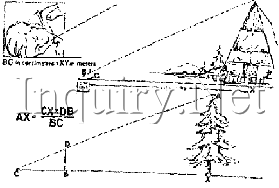
Line of Sight and a Measured Stick

Here is another method you can use to measure a tree or building:

1. Measure along the ground from the base of the building out far enough so you can sight the top of the building from ground level at a comfortable angle.

2 Mark this distance off in nine units of equal length say, nine measured stick lengths.

3. Nine stick lengths out from the building, stand your stick upright and have a friend hold it.

4. Measure off one more unit past the stick.

5. Put your head to the ground and, getting your eye as close to the ground as possible, sight the top of the building.

6. Where your sighting line cuts the stick, have your friend make a mark. 

7. Measure the number of centimeters front that mark to the ground. This will closely equal the height of the building in meters This works out to the formula below:


Estimating the Width of a River

Here is a handy estimating method for Golfers and for groups setting out to erect pioneering structures.
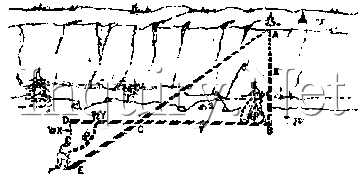
1: Pick out a point across the river, such as a tree (A).

2. Drive a stake (B) into the ground on your side of the river, in line with the tree.

3. Walking parallel to the river bank, make a baseline of any convenient length, say 40 m.

4. Drive a stake (C) into the ground.

5. Continue along the bank in the same direction for half the first distance you measured (20 m).

6. Mark the spot D.

7. Make a 90° turn (your back to the river) and walk inland until you can sight your first stake C in a line with the tree across the river. 

8. Mark the spot E.

9. Measure the distance between the stakes D and E.

10. Double this distance and you will come close to the actual width providing, of course, the sighting, measurements and angles are correct.

Judging Distance

Learn the exact length of your pace. Try to learn to pace an exact 3 meters distance with five of your paces (if you do this one kilometer will equal 1665 paces).

Remember things can appear nearer or further than they really are depending on how clearly you can see the outline. Also, if there is water between you and an object, the distance can be deceptive.

1. Objects seem further away:

(a) When they are in the shade,
(b) Across a valley,
(c) When they are the same color as the background,
(d) In a heat haze,
(e) When you are lying down or kneeling.

2. Objects seem closer:

(a) With the sun behind you, 
(b) In very clear air,
(c) When a different color from the background, 
(d) When the ground is fiat (or snow covered), 
(e) When it is larger than other objects nearby,
(f) When you are looking across water, or a deep valley.

3. Visible objects seen nearer at night than during the day.


Remember they eye measures distance "as the crow flies', and does not allow for uneven terrain. In other words actual distance may be greater than visual distance.

Examples

At 700 meters a man looks like a post. 
At 650 meters the head is not yet visible. 
At 550 meters the head is visible as a dot. 
At 450 meters he appears bottle shaped.
At 350 meters movement of the legs can be seen. 
At 250 meters the face can be seen.
At 200 meters details of clothing are recognizable. 
At 100 meters eyes and mouth can be seen clearly.

 See Also:

Estimation for Scouts

White Man's Woodcraft

Traditional Training Handbook
©2003 Baden-Powell Scouts Association


Additional Books

Site Contents
[Warning: Large File]

Search  Inquiry Net

Back Home Up Next


Additional Information:

Peer- Level Topic Links:
Cooking Lightweight ] Cooking Off-the-Shelf ] Cascade Mountain Climb ] Camp Schoellkopf: October 2007 ] Equipment, Lightweight ] Equipment, Scouting Out ] Learn by Doing ] The Scout's Staff ] Archery ] Axe, Boy Scout ] Axe, Saw, Forestry ] Axe, Saw,  Knife ] Axe Use: Beard ] Axe Use: Seton ] Axe Use: Traditional ] Axe Throwing ] Beds, Woodcraft ] Bedding Materials ] Bicycle Maintenance ] Birch-Bark Torch ] Birds ] Bird Houses ] Blocks Tackles Purchase ] Blood Red Cross ] Broom: Camp or Witch's ] Buttons ] Campcraft ] Camp Hygiene ] Camp Planning ] Campfire Programs ] Chainsaws ] City-Craft ] Compass Bear Song ] Compass, Home-Made ] Cookery in Camp ] Cooking Contests ] Cook Dutch Oven Stack ] Cooking Hygiene ] Cooking Utensils ] Cooking Primitive ] Cooking Recipes ] Cotton Kills Bear Song ] Deduction in Tracking ] Deduction & Detective ] Drum ] Dyes ] Edible Plants ] Equipment, Leader ] Equipment, Personal ] Equipment Maintenance ] [ Estimation ] Field Signals ] Fire Building ] Fire Laying ] Fire Lighting ] Fire Starters ] Fire: Rubbing-Stick ] Fire Types, Wood Types ] Fire Council Ring ] Fires: Woodcraft ] First Aid ] First Class Journey ] Flint & Steel ] Flowers ] Forest ] Gesture Signals ] Ground to Air Signals ] Handicraft Stunts ] High Adventure ] Hiking ] Hike Planning ] Indian Sundial Clock ] Insect Collecting ] Insect Preserve ] Indian Well ] Knife & Hatchet ] Knots, Bends, Hitches ] Knots: Diamond Hitch ] Knots: Lashings ] Knots: Rope Work ] Knots: Seton ] Knots: Traditional ] Knots & Whipping ] Lashings ] Lashing Practice Box ] Lace or Thong ] Leave No Trace ] Lights ] Local Knowledge ] Log Ladders, Notched ] Log-Rolling ] Logs: Cut Notch ] Logs Split with Axe ] Loom and Grass Mats ] Lost in the Woods ] Manners ] Maps ] Map & Compass ] Maps: Without Compass ] Measurement ] Measurement Estimation ] Menu Worksheet ] Menu (Adult IOLS) ] Mosquitoes ] Mushrooms ] Night Tracking ] Observation ] Old Trails ] Paints ] Pioneering, Basic ] Pioneering Models ] Plaster Casts ] Preparations ] Proverbs ] Rake ] Rope Care ] Rope Making ] Rope Spinning ] Scout Reports ] Signal & Sign ] Sign Language ] Silent Scout Signals ] Smoke Prints ] Snakes ] Spanish Windlass ] Spoons ] Staff/Stave Making ] Stalking Skills ] Stalking & Observation ] Stars ] Stools ] Story Telling ] Stoves & Lanterns ] Summoning Help ] Sun Dial: Scientific ] Survival Kit ] Tarp Poles ] Teepee (4 Pole) ] Tent Care ] Tent Pitching ] Tom-Tom ] Tomahawk Throwing ] Tomahawk Targets ] Totem Making ] Totem Animals ] Totem Poles ] Training in Tracking ] Tracks, Ground, Weather ] Tracking & Trailing ] Trail Following ] Trail Signs & Blazes ] Trail Signs of Direction ] Trail Signs: Traditional ] Trail Signs for Help ] Trees of the NE ] Wall Hangings ] Watch Compass ] Weather Wisdom ] Wild Things ] Troop 625 ]

Parent- Level Topic Links:
Outdoor Skills ] Games for Boys! ] Shelters ] Camp Fires ] Night Skills ] Native American ] Checklists ] WINTER ] SPRING ] SUMMER ] AUTUMN ] Activities ]

The Inquiry Net Main Topic Links:
Traditional Scouting ] Adult Association ] Advancement ] Ideals ] Leadership ] Outdoors ] Patrol Method ] Personal Growth ] Uniforms ]

Search Amazon.Com:
W
hen you place an order with Amazon.Com using the search box below, a small referral fee is returned to The Inquiry Net to help defer the expense of keeping us online.  Thank you for your consideration!

Search:
Keywords:
Amazon Logo


 DVDs for Junior Leader Training Weekends!


Additional Titles: Scout Books Trading Post

Dead Bugs, Blow Guns, Sharp Knives, & Snakes:
What More Could A Boy Want?

Click on Underlined Green text to follow a hyperlink.  Let me know if you find a broken link, especially those that reference a hard drive :-/

Click on Small Pictures to Enlarge Them.  
If this enlarged picture won't print on a single page, search your software for a printing option like "Best Fit."  This is the default setting in most browsers.  
If the pictures are missing, send me the URL, and I'll scan them for you.  

To Email me, replace "(at)" below with "@"
Rick(at)Kudu.Net
If you have questions, you must send me the URL!
The URL tells me what page you're talking about.  This URL is sometimes called the "Address" and it is usually found in a little box near the top of your screen.  Most URLs start with the letters "http://"
Did I mention that you must send me the URL?

©2003, The Inquiry Net, www.inquiry.net: In addition to any Copyright still held by the original authors, the Scans, Optical Character Recognition, extensive Editing,  and HTML Coding on this Website are the property of the Webmaster, Rick Seymour.   My work may be used freely by individuals for non-commercial, non-web-based activities, such as Scouting, research, teaching, and personal use so long as this copyright statement is included in the text
The purpose of this Website is to provide access  to hard to find, out-of-print documents.  Much of the content has been edited to be of practical use in today's world and is not intended as historical preservation.   I will be happy to provide scans of specific short passages in the original documents for people involved in academic research.  

The Kudu Net is a backup "mirror" of The Inquiry Net.  When linking to this Website, note that pages that end in "inquiry.net" are updated far more often than the corresponding "kudu.net" versions.

Old School Scouting:
What to Do, and How to Do It!

Hit Counter
Since August 24, 2002
+550,762

Last modified: May 01, 2005.